
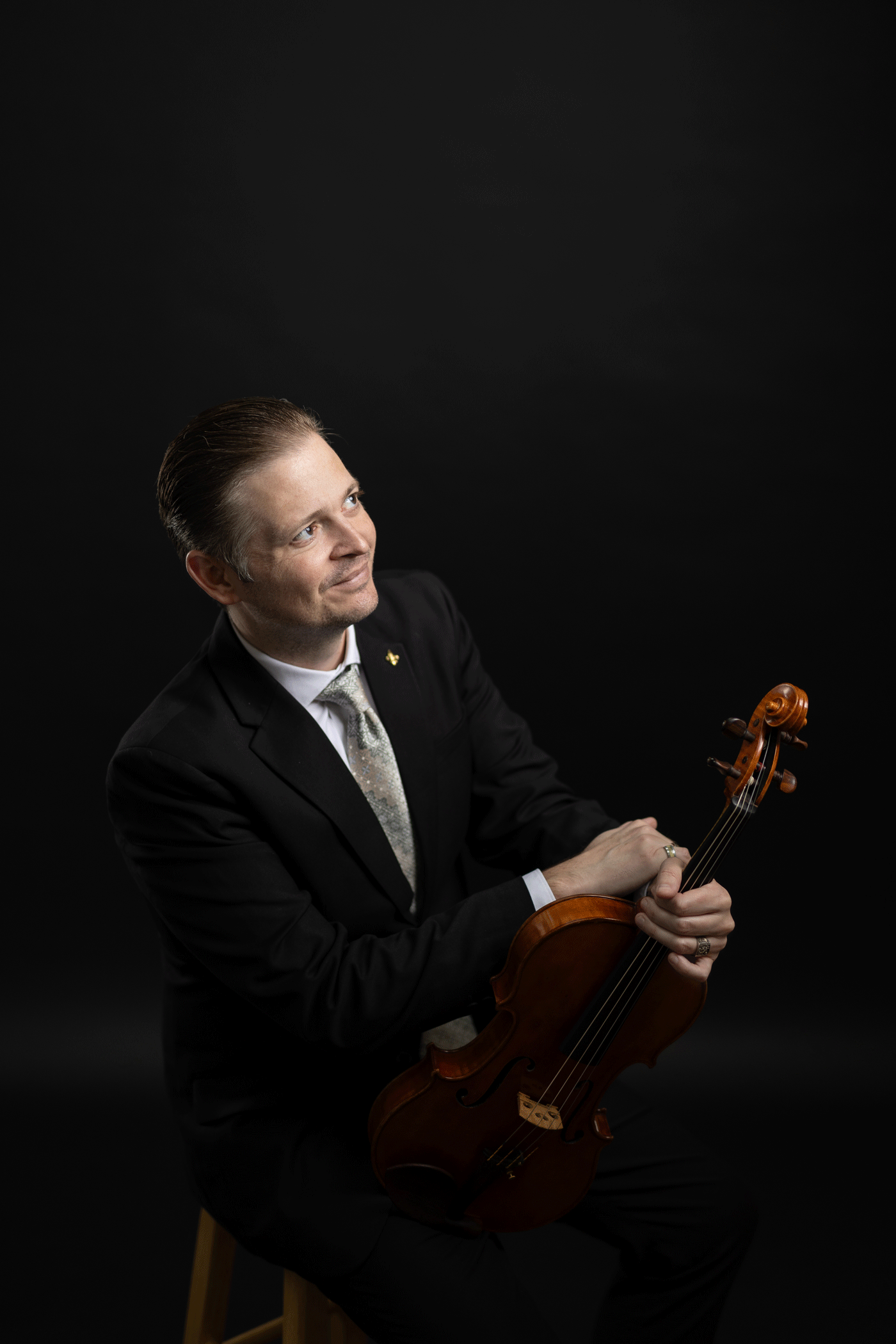
Kevin Nordstrom
Violist Kevin Nordstrom leads a vibrant and multifaceted career as a performer, teacher, scholar, and music producer. He has appeared as a soloist, recitalist, chamber musician, teacher and clinician throughout North, Central, and South America, Europe, and Asia, and has served on the string faculties of the University of Louisville, Wright State University, and Earlham College. His albums and recordings can be heard on all major digital platforms released by his own imprint Ambleside Records – where he serves as artist/producer – Oclassica Records, and the American Viola Society.
As a performer, Dr. Nordstrom specializes in late Romantic, twentieth century, and contemporary repertoire. He has earned recognition for his compelling interpretations of cornerstone works for the viola, especially sonatas by Paul Hindemith, while also contributing significantly to the revival of overlooked pieces such as those by American composer Marion Bauer and French composer Charles Koechlin. Among his signature works are Joan Tower’s Wild Purple and Simply Purple for solo viola, and her Purple Rhapsody viola concerto. Recent notable engagements include solo recitals at the International Performing Arts Center in Seoul, South Korea, and on the Persona Contemporary and Exploratory Concert Series in Medellín, Colombia.
A dedicated advocate for new music, Dr. Nordstrom collaborates closely with living composers at all stages of their careers. Several solo and chamber works have been written for him by Alyssa Morris, including her Puccini Fantasy for Viola and Piano (2021), a virtuosic and expressive work he has performed widely and recorded on his album Works for Viola by American Women Composers. Additional works include The Big Questions for oboe, viola, and piano (2024), as well as a forthcoming viola concerto. Dr. Nordstrom has also performed extensively the music of Colombian composer Rodolfo Acosta R., including Playas for solo viola (2005), vi tu cara, y sentí vértigo y lloré for solo improviser (2011), and Archipiélagos de la esperanza for viola and cello (2003).
As a chamber musician, Dr. Nordstrom performs regularly with the Aurelian Trio and in a duo with his violinist brother, Dr. Stephen Nordstrom. With both ensembles, he explores cornerstone repertoire while actively championing and commissioning works by composers from across the Americas including Manuel Ponce, Heitor Villa-Lobos, and Allan McCullough as well as music by Icelandic composer Anna Thorvaldsdottir and Estonian composer Mirjam Tally.
As a scholar, Dr. Nordstrom presents frequently at conferences and contributes articles to professional journals. A committed member of the College Music Society (CMS), he has lectured on and performed music by György Ligeti, Charles Koechlin, Marion Bauer, Lillian Fuchs, Alyssa Morris, and Joan Tower at both regional and national meetings. His dedication to advancing string education has led to clinic presentations for the Texas, Pennsylvania, and Ohio Music Educators Associations, as well as multiple appearances at American String Teachers Association (ASTA) National Conferences. His writings appear in the American String Teacher journal and the Journal of the American Viola Society (JAVS), where he has also served on the editorial board. Within CMS, he has held leadership roles including Program Chair and Treasurer for the Great Lakes Chapter.
Dr. Nordstrom studied at the University of North Texas, the University of Southern California, and the University of Cincinnati College Conservatory of Music. His principal teachers include Dr. Kathryn Steely, Dr. Susan Dubois, Donald McInnes, Masao Kawasaki, and Dr. Catharine Carroll-Lees. He performs on a fine 1893 viola by the distinguished American luthier Jerome Bonaparte Squier, along with bows crafted by Richard Grünke, Martin Devillers, Emile Blondelet, and Douglas Raguse. Beyond his musical life, Kevin is an avid golfer, reader, cooker of food and connoisseur of drink, and above all a devoted family man.
Teaching Philosophy
In my viola studio, I cultivate an environment where learning and application are central to both student and teacher. I guide students to develop steadily into accomplished performers and teachers through a structured and reflective learning process. My teaching builds musicianship, technique, and professional skills; it develops a detailed “practice-room vocabulary” that will advance the students’ playing and become the teaching vocabulary they use with students of their own. I ensure that each student knows that practice and work ethic are the foundations of their professional life so that they can pride themselves on their performing and teaching excellence.
Building musicianship and technique are top priorities in my studio, so students become respected professional performers who can communicate their playing knowledge to others. Musicianship is developed by selecting repertoire based on individual needs and interests. For example, if a first-year student needs to work on tone production and using varied tone colors to shape phrases, they may be asked to choose either the Primrose arrangement of CPE Bach’s Sonata in g minor, Hindemith’s Trauermusik, or Bloch’s Meditation and Processional. The piece that is chosen is the one the student has affinity with, and the pairing will grow their sense of how mechanics and artistry are intertwined.
Musicianship is also developed through fun studio projects. One such project is Bachtoberfest, where each student prepares one or more movements of solo Bach for performance at the end of October. They also do a short research assignment on a member of the Bach family presented at the performance.
Scales and etudes are crucial for building technique and are heard during weekly lessons and scales class. At semester’s end, each student performs a scale jury. Requirements for this jury follow progressive guidelines I have tailored to degree type (performance, education, therapy, etc.) and lesson level (100, 200, etc.). This system has been remarkably fruitful, and my students regularly report that it has enhanced their practice routine and confidence on their instrument.
Involving students in recruitment activities is an effective way to demonstrate how practice room habits become professional skills. My annual Viola Workshop at the University of Louisville is an example of this. During the workshop, my undergraduate students mentor attendees, and graduate students help with breakout sessions designed to give more individualized attention. Thus, all make important contributions, and gain experience verbalizing and demonstrating their practice-room vocabulary.
My viola and string literature/pedagogy courses likewise help students develop material they can build upon as they enter the music profession. For example, in the viola pedagogy course they write an original technique article following the official guidelines of the Journal of the American Viola Society or American String Teacher journal. Throughout the semester, a topic is refined and drafts prepared for review. Students are encouraged to submit their work to the above-mentioned journals, which has proven successful.
Central to my teaching is career mindedness and a focus on learning and application. My students are treated and supported as budding professionals. The repertoire and technique we work on strengthens their playing, ensuring it is competitive, the events they contribute to give them organizational experience and a venue for verbalizing practice room vocabulary, and their classwork gives them refined materials which they can use to confidently establish themselves in the profession.
Teaching Philosophy
In my viola studio, I cultivate an environment where learning and application are central to both student and teacher. I guide students to develop steadily into accomplished performers and teachers through a structured and reflective learning process. My teaching builds musicianship, technique, and professional skills; it develops a detailed “practice-room vocabulary” that will advance the students’ playing and become the teaching vocabulary they use with students of their own. I ensure that each student knows that practice and work ethic are the foundations of their professional life so that they can pride themselves on their performing and teaching excellence.
Building musicianship and technique are top priorities in my studio, so students become respected professional performers who can communicate their playing knowledge to others. Musicianship is developed by selecting repertoire based on individual needs and interests. For example, if a first-year student needs to work on tone production and using varied tone colors to shape phrases, they may be asked to choose either the Primrose arrangement of CPE Bach’s Sonata in g minor, Hindemith’s Trauermusik, or Bloch’s Meditation and Processional. The piece that is chosen is the one the student has affinity with, and the pairing will grow their sense of how mechanics and artistry are intertwined.
Musicianship is also developed through fun studio projects. One such project is Bachtoberfest, where each student prepares one or more movements of solo Bach for performance at the end of October. They also do a short research assignment on a member of the Bach family presented at the performance.
Scales and etudes are crucial for building technique and are heard during weekly lessons and scales class. At semester’s end, each student performs a scale jury. Requirements for this jury follow progressive guidelines I have tailored to degree type (performance, education, therapy, etc.) and lesson level (100, 200, etc.). This system has been remarkably fruitful, and my students regularly report that it has enhanced their practice routine and confidence on their instrument.
Involving students in recruitment activities is an effective way to demonstrate how practice room habits become professional skills. My annual Viola Workshop at the University of Louisville is an example of this. During the workshop, my undergraduate students mentor attendees, and graduate students help with breakout sessions designed to give more individualized attention. Thus, all make important contributions, and gain experience verbalizing and demonstrating their practice-room vocabulary.
My viola and string literature/pedagogy courses likewise help students develop material they can build upon as they enter the music profession. For example, in the viola pedagogy course they write an original technique article following the official guidelines of the Journal of the American Viola Society or American String Teacher journal. Throughout the semester, a topic is refined and drafts prepared for review. Students are encouraged to submit their work to the above-mentioned journals, which has proven successful.
Central to my teaching is career mindedness and a focus on learning and application. My students are treated and supported as budding professionals. The repertoire and technique we work on strengthens their playing, ensuring it is competitive, the events they contribute to give them organizational experience and a venue for verbalizing practice room vocabulary, and their classwork gives them refined materials which they can use to confidently establish themselves in the profession.